


Ms. Anjena Seewooruthun, Director & Change Management Expert, Saska Consulting Ltd
Mr. Soon Koi Voon Founder and Director, The Praxellence Centre Ltd
Mr. Tan Kim Leng, Founder and Director, The Praxellence Centre Ltd
In an era of rapid digital transformation, personal identity (ID) has evolved from being a purely administrative function. Modern identity systems are reshaping how individuals interact with government institutions, offering secure, inclusive access to public services. ID is now a foundation of a digital trust ecosystem necessary to ensure a robust digital society and economy.
Between 2012 and 2014, Mauritius transitioned from paper-based laminated ID cards to a new smart biometric card. The objective was to modernize digital infrastructure, strengthen security, and enhance public service delivery.
This paper examines the challenges of disruption, transition, and implementation from a practitioner’s perspective. It identifies broader implications for public sector transformation and offers practical insights for practitioners and policymakers undertaking similar identity reform initiatives. The authors, key members of the Programme Management Office (PO), provided strategic oversight, structured governance, and coordinated delivery across technical and operational workstreams. The PO played a critical role in tracking progress, aligning stakeholders, enabling change, and managing risks.
Project Background and Objectives
Between 2012 and 2014, Mauritius undertook a major identity system reform through the Mauritius National Identity Scheme (MNIS), modernising its outdated paper-based laminated ID card from 1986 with a new smart biometric card. The initiative aimed to strengthen national security, improve citizen data reliability, and enhance service delivery while supporting Mauritius’s digital government strategy and trusted digital economy ambitions.
Fig 1: MNIS Initiative Timeline
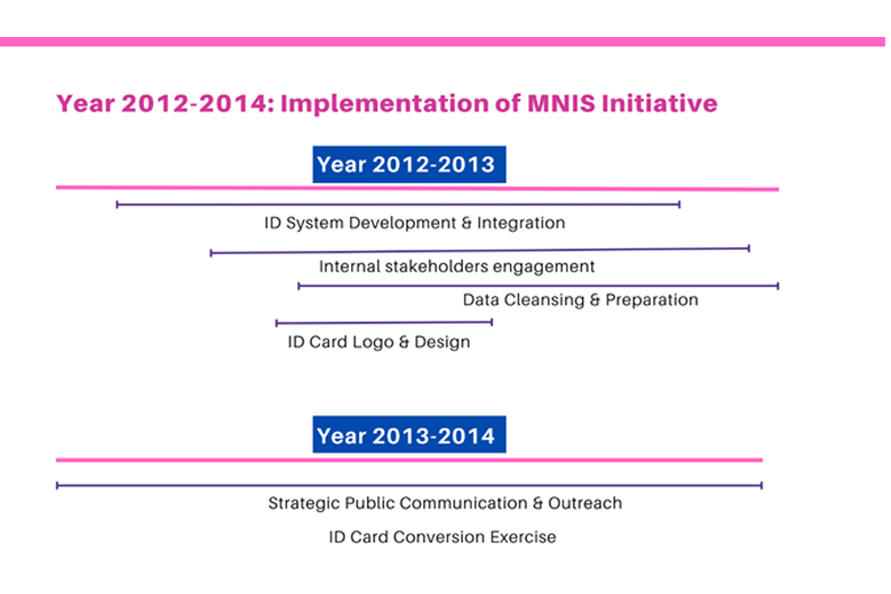
The MNIS initiative was a G2G collaboration between the Singapore Corporation Enterprise and the Government of Mauritius. Major programme components included data cleansing, ID system development, card design and the conversion exercise. The implementation was supported by change management, risk management and public outreach.
The SCE consortium established a Programme Management Office (PO) for delivery oversight, governance and accountability. The PO managed the project through workgroups covering Legal & Policy, Technical systems & Infrastructure, Conversion Operations, Data Governance, Risk Management and Change Management. The project was governed through a steering committee, a working committee, workgroups and sub-committees with two key goals: (1) Achieve the set target for new ID cards issued (2) Meet the timeline for the conversion exercise.
Key Implementation Challenges and Responses
Mediating Conflicting Institutional Goals
A programme of this scale required the involvement of multiple government institutions, each with distinct mandates and priorities. The Ministry of ICT focused on technological robustness and future interoperability; the IT Security department prioritized cybersecurity; the Ministry of Finance sought quantifiable benefits; the Civil Status Division was concerned with the operational transition from manual to digital systems; and the Police focused on physical security of the ID card. Each institution approached the programme through its own lens, wearing its institutional “hat” first.
To align these divergent perspectives, we adopted a Whole-Of-Government (WOG) approach. UNDESA (2014) emphasizes WOG is essential to overcome “silos” mentality and promote an integrated approach.
Our WOG approach was deployed through three strategies:
- Articulating a Shared Vision: A unifying, inspiring vision of the programme’s national significance was consistently reinforced. The chairperson of the monthly Steering Committee meetings played a key role in embedding this vision, helping stakeholders see beyond institutional silos.
- Commissioning a High-Level Sponsor: Recognizing the need for authority that went beyond institutional boundaries, the programme was chaired by the Office of the Prime Minister, represented by the Senior Chief Executive. This strategic condition, recommended by SCE advisors before the kick-off, ensured clear leadership and swift resolution of inter-ministerial blockages. When bureaucratic obstacles emerged, the Sponsor was able to intervene decisively, either through hierarchical authority or peer engagement at the highest levels.
- Facilitating Bilateral Engagements: The PO also led targeted engagement with each institution. These bilateral dialogues ensured that stakeholder concerns were acknowledged and addressed while simultaneously fostering awareness of other agencies’ constraints. This helped cultivate mutual understanding and paved the way for negotiated compromises around shared goals. Importantly, as noted by Othman, Razali, and Faidzul (2025), the project team itself can act as a crucial enabler of WOG coordination by serving as a trusted intermediary that facilitates institutional alignment and encourages collaborative problem-solving across ministries.
Achieving Operational Agility for Service Delivery Complexity
The nationwide mass conversion exercise took place over one year, from October 2013 to September 2014. It required significant operational agility and real-time responsiveness. The call to citizens, enrolment operations, and new card production and distribution had to be efficient and synchronised. A practitioner-led, outcome-focused Programme Office (PO) framework, inspired by supply chain operations principles was critical to this achievement.
By the end of September 2014, over 900,000 citizens had received their smart ID cards, exceeding the project target. Delivering this level of coverage within such a compressed timeline was a testament to the strategic coordination and executional capability of the operational team.
Data Driven Adaptability
At the outset, only four operational ID card centres were active, including one on Rodrigues Island. The number of conversion centres was scaled up to ten, supported by the recruitment and training of contractual staff. The card personalisation centre also operated overtime to meet the delivery schedule.
Operational realities on the ground presented multiple challenges: long queues, hot weather, early crowding (with citizens arriving hours before opening), and the need to ensure inclusive operations for disabled and bedridden individuals. Feedback from citizens was gathered through multiple channels: help desk call log, questions from MNIS Facebook page and MNIS website, and in-person through service ambassadors.
The PO played a central role in continuously recalibrating the operational strategy based on real-time performance data from each centre, using Tableau dashboards to support data-driven decision-making.
An operations monitoring framework was introduced, incorporating KPIs such as average wait time, document processing time, biometric capture duration, and total enrolment time per citizen. Based on these insights, several process optimisations were rolled out, including straight-through processing, dedicated exception-handling desks, and a ticketing system to manage throughput and reduce bottlenecks.
Additional service design measures were deployed to improve the citizen experience: fast-track lanes for senior citizens, home visit options for people with disabilities, a corporate service for on-site enrolment at large private sector companies and regional mobile units. Service ambassadors were deployed at each centre, with comfort enhancements such as drinking water and fans introduced to improve the environment.
This experience underlines the value of responsive operations management, real-time data use, and human-centred service design in achieving service coverage at scale while maintaining public trust. It also reflects practices later formalised in frameworks such as the SCOR Digital Standard (ASCM, 2022) and adaptive/hybrid lifecycle models introduced in the PMBOK® Guide – Sixth Edition (PMI, 2017), reinforcing the project’s forward-looking operational model.
Establishing Strong Data Governance Foundation
Data quality emerged as a major underestimated challenge in the MNIS initiative due to the absence of formal data governance within the Civil Status Division. Issues included poor standardisation, completeness, and accuracy of digitised records, while many citizen records remained in manual form requiring full digitisation.
The PO identified this as a critical dependency and responded by reallocating resources and appointing a dedicated data governance expert. This expert assessed the data landscape, designed a governance framework compliant with national standards, developed SOPs, trained government officers, and led a comprehensive data cleansing and digitisation effort prior to citizen registration. Without these measures, the smart ID card rollout would have been severely compromised. ID4D Practitioner’s Guide (World Bank, 2019), later, recognised the importance of assessing the quality and robustness of existing data sources before digitisation and enrolment, warning that unverified or incomplete data can undermine the integrity of foundational ID systems.
Data challenges are not unique to Mauritius. In other digital transformation initiatives that we managed, gaps in data governance were also encountered e.g. in Namibia’s digital transformation to improve the business climate and in the businessNOW Fiji project. These experiences emphasize the importance of embedding data governance mechanisms as early design-stage components of any digital transformation initiative.
Data governance is not just a technical necessity but a strategic enabler of trust and operational efficiency supporting digital transformation (OECD, 2019).
Public Engagement and Addressing Legal-Ethical Complexities
Public engagement
MNIS implemented a comprehensive public communication strategy to raise awareness and drive registration for the new ID cards. A strong brand identity was developed, with an impactful logo and a unifying slogan. The whole process included focus groups consultations and was coordinated across ministries via a communication sub-committee.
The multi-channel campaign included press briefings, radio and TV shows, website and social media engagement, roadshows, print materials, and feedback points at conversion centres. Citizens were informed about the conversion process, available centres, required documents, and card features. Each conversion centre had a “Tell Us – Dir Nou” service feedback point.
Targeted campaigns were also done for public and private sector institutions involved in service delivery leading to mobile units being deployed for on-site staff conversions. The communication efforts proved successful, improving citizen understanding and administrative readiness while contributing to exceeding the target of newcards issued. Effectiveness was measured through tracking citizens with missing documents and weekly registration figures at conversion centres.
Resistance, ethical concerns and legal challenges
However, despite the extensive communication outreach, citizens’ concerns were not fully assuaged, and resistance still emerged. The smart ID card tested the boundaries of what the Mauritian public was willing to accept in relation to state collection of biometric data.
Biometric data collection remains a globally sensitive and contested issue. Similar tensions have been observed elsewhere. In the UK, the national ID card scheme launched in the early 2000s faced strong public backlash, civil society protests, and widespread concerns about state surveillance and data misuse, ultimately leading to its repeal in 2010 (NO2ID, 2009; UK Parliament, 2010). In Kenya, the Huduma Namba initiative aimed to establish a national digital ID system linked to biometric data, but it faced sustained legal and civic opposition due to concerns over data protection, consent, and exclusion. The High Court ruled that implementation could not proceed without a robust legal framework, delaying the issuance of the proposed smart ID card (Kenya High Court, 2020). A successor initiative, Maisha Namba, is now being piloted, but it too faces scrutiny over governance, transparency, and public trust.
In Mauritius, resistance was about fingerprints capture and storage, primarily driven by concerns over surveillance, data privacy, and government overreach. Scepticism persisted despite assurances from the Data Protection Office. Despite, the increasing number of citizens’ enrolment for the smart ID card, these anxieties culminated in a constitutional challenge before the Supreme Court. The full bench judgement came out after project completion and ruled that the legal provisions allowing for the centralised storage and retention of biometric fingerprint were unconstitutional (Madhewoo v. The State, 2015). In response, the government amended its regulatory framework: biometric fingerprint would no longer be stored in a central database but only embedded within the ID card chip itself.
The concerns raised in Mauritius and globally demonstrate that even when legal frameworks and data protection laws are in place, their robustness may be questioned, particularly where there is underlying public mistrust in government or institutions. The challenge of explaining disruptive technologies in accessible, relatable terms is also a factor to consider. As digital technologies increasingly mediate the relationship between state and citizen, trust becomes a critical enabler of adoption (OECD, 2019). Without it, even well-intentioned and secure systems can face resistance or rejection, especially when sensitive personal data involving biometric being abused and/or misused are key concerns.
Conclusion and Reflections
The transformation of Mauritius’ national identity system from paper-based cards to a secure, biometric smart ID was more than a technical upgrade—it was a complete shift that tested the country’s institutional agility, legal frameworks, and operational readiness. The experience demonstrated that digital transformation is not only about deploying new technologies but about navigating people, policies, and processes in parallel.
Four key lessons emerged from this implementation:
- Early alignment among institutions with competing mandates is critical and depends heavily on empowered, high-level sponsorship.
- Large-scale operations require adaptive management grounded in real-time data.
- Data governance must not be overlooked or deferred; their absence can derail even the most well-planned implementations.
- Public trust is fragile, especially around biometrics. This indicates that public trust in institutions and not just the technology, is critical. Democratic contexts must acknowledge that civil society, media, and the judiciary are integral to digital transformation.
As governments across the world pursue digital identity systems, the Mauritius experience offers practical insights for practitioners and policymakers. It stresses that successful digital transformation is not a one-time technical delivery but an ongoing process of institutional coordination, cultural adaptation, and public accountability.
APA Reference list:
Association for Supply Chain Management. (2022). SCOR Digital Standard: Supply Chain Operations Reference Model. ASCM.
Kenya High Court. (2020). Nubian Rights Forum & others v. The Attorney General & others. eKLR. Retrieved from https://kenyalaw.org/caselaw/cases/view/189189/
Madhewoo v. The State, [2015] SCJ 177 (Supreme Court of Mauritius), https://www.jcpc.uk/cases/jcpc-2016-0006#appeal
NO2ID. (2009). A campaign against the database state. Retrieved from https://www.no2id.net/
OECD. (2019). The path to becoming a data-driven public sector. OECD Publishing. https://doi.org/10.1787/059814a7-en
Othman, M. H., Razali, R., & Faidzul, M. (2025). Towards integrated e-government services: Key contributing factors from a whole-of-government perspective. Journal of Applied Science, Engineering, Technology, and Education, 7(1). https://doi.org/10.35877/454RI.asci3800
Project Management Institute. (2017). A guide to the project management body of knowledge (PMBOK® Guide) – Sixth edition. PMI
Supply-Chain Council. (2012). Supply Chain Operations Reference (SCOR) model, Version 11.0.
United Nations Department of Economic and Social Affairs (UNDESA). (2014). Whole of government and collaborative governance. In United Nations E‑Government Survey 2014: E‑Government for the Future We Want
UK Parliament. (2010). Identity Documents Act 2010. Retrieved from https://www.legislation.gov.uk/ukpga/2010/40/contents
World Bank. (2019). ID4D Practitioner’s Guide: Version 1. Washington, DC: World Bank Group. Retrieved from https://id4d.worldbank.org/guide
Further Reading:
Chiumbu, S., & Chan-Meetoo, C. (2024, July). Policy brief – Smart ID cards in Mauritius: Balancing rights and freedoms with national identification needs. Retrieved from https://intelwatch.org.za/wp-content/uploads/2024/08/Mauritius-smart_ID_card_amendments_v2_fin.pdf
ID4Africa. (2021, February 11). EP12: The identity ecosystem of Mauritius [Video]. YouTube. https://www.youtube.com/watch?v=9pddDoG9EMQ&t=13s
Supreme Court of India. (2018). Justice K.S. Puttaswamy (Retd.) vs Union of India, Writ Petition (Civil) No. 494 of 2012. Retrieved from https://indiankanoon.org/doc/127517806/
Further Reading from the Authors:
Endeavour. (2024). Digital government transformation handbook. https://lnkd.in/gnbHDYvv
Harkrider, N., & Tan, K. L. (2013). Leading change that matters: Making adoption a reality. https://www.amazon.com/Leading-Change-that-Matters-Adoption/dp/9810780311
Seewooruthun, A. (2017). Facilitating change: Connecting people to the change (Managing Change Companion Series). https://www.amazon.com/Facilitating-Change-Connecting-Managing-Companion/dp/9811123640?ref_=ast_author_mpb
Main photo from Freepik
Charles Telfair Centre is an independent, nonpartisan not for profit organisation and does not take specific positions. All views, positions, and conclusions expressed in our publications are solely those of the author(s).