


Original Article by:
Verena Tandrayen-Ragoobur, Associate Professor in Economics; Dean, Faculty of Social Sciences and Humanities at the University of Mauritius
Executive Summary
- Road accidents are a growing global and national issue, with Mauritius experiencing a 41% increase in crashes from 2010 to 2020, despite national safety strategies.
- Traffic accidents negatively impact Mauritius’ economy, with a 1% rise in accidents reducing GDP by 0.42%, mainly through productivity loss and increased public healthcare spending.
- Mauritius faces unique challenges as a small island state, including limited infrastructure and emergency response capacity, amplifying the socio-economic costs of accidents.
- Adopting the WHO Safe System Approach and improving road infrastructure, enforcement, and public awareness are key to reducing fatalities, boosting economic resilience, and improving quality of life.
The Context
Traffic accidents and injuries imply a significant socioeconomic and public health concern. Despite constant efforts by government agencies and non-governmental organisations to enhance road safety, the number of traffic accidents and the resulting fatalities have steadily increased over the last ten years across many countries. From a global perspective, the increase in the number of road accidents is considered as a serious problem for policy makers. Figures from the WHO confirm an increase in the number of deaths from roads accidents, from 1.15 million in 2000 to 1.35 million in 2018. This poses various adverse implications socially and economically as well.
Road traffic accidents represent a serious economic burden, resulting in tragic deaths, terrible injuries, and substantial financial expenses. Different methods are used to evaluate the impact of road traffic accidents, particularly by assessing their socio-economic costs. These evaluations often consider both direct and indirect costs or rely on approaches such as the Value of Statistical Life (VSL), which estimates individuals’ willingness to pay to reduce accident-related risks. Road accidents can affect GDP through several interrelated mechanisms, including:
Medical Expenditures – Costs associated with emergency care, hospitalization, and long-term medical treatment for accident victims.
Loss of Productivity – Economic loss resulting from temporary or permanent disability, or premature death of working-age individuals.
Property Damage and administration costs – Costs of repairing or replacing damaged vehicles and infrastructure. Expenditures related to law enforcement, insurance processing, and legal proceedings following accidents.
Transport disruption – Accidents often cause road blockages, leading to travel delays and reduced efficiency for businesses and workers.
Infrastructure damage – Vehicle collisions or heavy braking exacerbate existing road defects, accelerating pavement deterioration
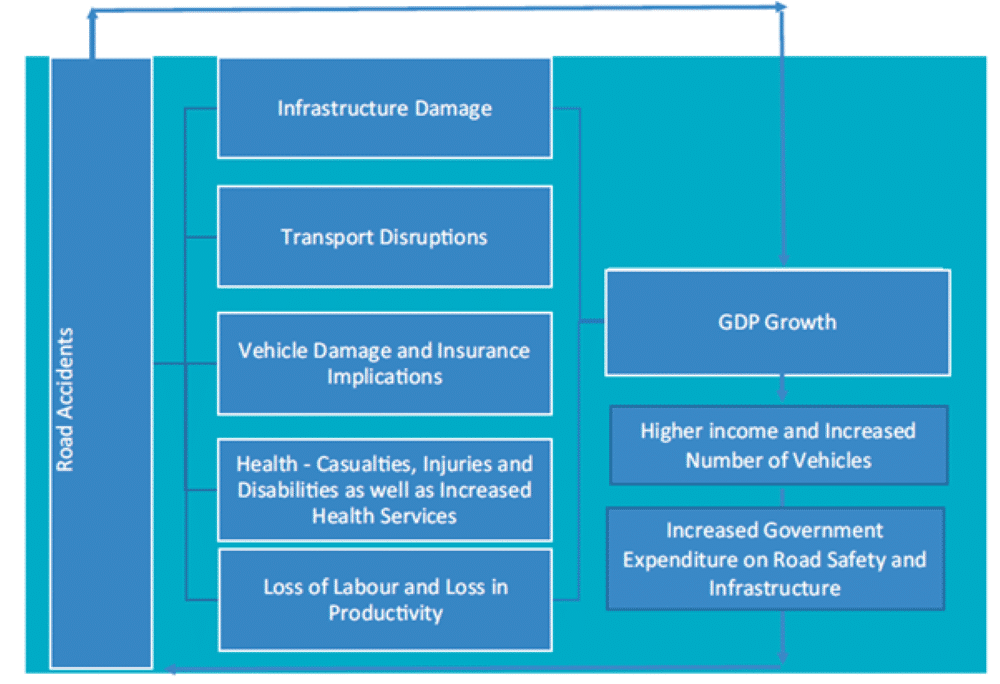
Figure1: Conceptual Framework linking Road Accidents and GDP in a Small Country Setting. Source: Author’s Computation 2023.
The Economic Burden of Road Traffic Accidents and Injuries – The case of Mauritius
Focusing on the Mauritian context, with a rise in the number of registered vehicles and an increase in infrastructural projects, the number of road accidents has been peaking over the past years. Latest figures from Statistics Mauritius confirm this rising tendency with a rise of 41% in the number of road accidents from 2010 to 2020. Furthermore, even though the country developed a National Road Safety Strategy 2016–2025 (Road safety: A national urgency) with the goal of reducing the number of fatalities and serious injuries from traffic accidents by 50% by 2025, traffic accidents and fatalities continue to be a significant problem. Mauritius recorded a road traffic injury death rate of 12.2 per 100,000 population, significantly lower than the Sub-Saharan African average of 27.4, yet considerably higher than the average of 8.4 observed in high-income economies. The economic impact of road accidents on GDP varies depending on factors such as a country’s size, geographic location, economic structure, and available resources. In this context, small island states like Mauritius often face unique challenges that differentiate them from larger, mainland countries, including limited infrastructure capacity, constrained emergency response systems, and heightened vulnerability to systemic shocks.
The methodology
As part of this research , an econometric model is applied to study the impact of road accidents on the Mauritian Economy. The system used to test the nexus between both variables is the Vector Error Correction Model, commonly known as the VECM. The objective is to assess the short-run and the long-run impacts of road accidents and injuries on the Mauritian GDP using data for a timeframe of 41 years (from 1980 to 2020).
Road accidents and economic growth
The results suggest that in the long run, road accidents in Mauritius have a negative correlation with real GDP. A 1% increase in road accidents will result in a 0.42% decrease in real GDP, assuming all other factors remain constant (ceteris paribus assumption). The estimated GDP loss in Mauritius is higher than the global average (0.36%) reported by the World Bank (2017).
The study also found a significant negative correlation between road traffic casualties and real GDP. On average, a 1% increase in road accident casualties results in a 0.18% decrease in real GDP, assuming other factors remain constant. In other words, there is inverse long-term link between road accidents, casualties and economic growth.
How does road accidents impact GDP?
There are two key mechanisms that could explain the negative relationship between road accidents, casualties and economic growth:
Productivity: Road traffic accidents and attached casualties can have a long-term impact on human capital and people’s capacity to work and Mauritius’ development is heavily reliant on its labour force. When accidents result in long-term impairments or reduced functional abilities, the labour market may face significant negative effects in the form of decreased worker productivity. Over time, such decline in labour productivity constrains GDP growth.
Public spending: Since Mauritius provides free healthcare, a rise in road accidents increases government spending and puts extra pressure on the health system . Injured individuals often need long-term medical care and rehabilitation, which raises healthcare costs. As a result, more public funds may be needed for treatment and support services, reducing the resources available for other important public investments.
What about in the short run?
In the short run, road accidents do not have a statistically significant impact on GDP, possibly due to offsetting positive effects with increase demand in vehicle repairs or private health services. As would be expected, in the short run an increase in the number of vehicles negatively affects GDP due to traffic congestion and its consequences on productivity and costs and has a significant positive effect on total number of casualties.
Finally, the data also show that higher GDP levels are associated with more road accidents, consistent with the theory that accidents rise with development until a threshold is reached.
Policy and Social Implications for Mauritius
The findings highlight the urgent need for Mauritius to prioritise road safety as a key element of sustainable development. Reducing road accidents can mitigate long-term economic losses and strengthen social welfare. Current initiatives such as vehicle checkpoints, speed monitoring, and drug and alcohol testing are important, but the country would benefit from adopting the Safe System Approach recommended by the World Health Organization. This strategy puts human being at its centre and include considerations for all elements in the road system: promotes safer roads, vehicle infrastructure, speed limits, and road user behaviour, post-crash care, acknowledging human vulnerability and system imperfections.
Beyond the economic costs, road accidents inflict significant social harm, including loss of life, long-term disability, psychological trauma, and pressure on families and healthcare systems. The social cost of fatalities and injuries associated with traffic accidents exceeds the financial impact. Grief and trauma influence the general well-being and social cohesiveness of families, communities, and society at large. Creating safer roads not only reduces fatalities and injuries but also enhances social cohesion, trust in public institutions, and citizens’ quality of life.
Moreover, safer roads encourage active mobility like walking and cycling which contributes to better health and a more inclusive, engaged society. Building a culture of road safety can therefore have far-reaching effects on both economic productivity and the well-being of individuals and communities in Mauritius.
Other research by the author:
Tandrayen-Ragoobur, V. (2022). The innovation and exports interplay across Africa: Does business environment matter? The Journal of International Trade & Economic Development, 31(7), 1041–1071.
Foley, A., Brinklow, L., Corbett, J., Kelman, I., Klöck, C., Moncada, S., Mycoo, M., Nunn, P., Pugh, J., Robinson, S.-A., Tandrayen-Ragoobur, V., & Walshe, R. (2023). Understanding “Islandness”. Annals of the American Association of Geographers, 113(8), 1800–1817
Tandrayen Ragoobur, V., & Narsoo, J. (2022). Early human capital: The driving force to economic growth in island economies. International Journal of Social Economics, 49(11), 1680–1695
Original article: The economic burden of road traffic accidents and injuries: A small island perspective
This summary has been co-written by Kilvanee Mootooperian, Freelance Writer at Charles Telfair Centre, in collaboration with original author.
Main photo from Freepik
Charles Telfair Centre is an independent nonpartisan not for profit organisation and does not take specific positions. All views, positions, and conclusions expressed in our publications are solely those of the author(s).