


Proceedings from Charles Telfair Centre National Workshop
Myriam Blin, Head, Charles Telfair Centre
Roslyn Fraser, Associate Professor of Sociology, Stephen F. Austin State University
Mauritius is facing a pivotal moment in its migration trajectory. Once a nation known for its significant diaspora, it now also positions itself as a destination, drawing in both low- and high-skilled migrants to meet labour market needs and attract investment. Indeed, the country is grappling with pressing demographic realities: a declining fertility rate, an aging population, and an increasingly constrained labour force.
In May 2025, a national workshop organised by the Charles Telfair Centre, brought together stakeholders from government, academia, civil society, international organizations, and the private sector to examine the complex and evolving migration landscape of Mauritius. The objective was not simply to review existing policies, but to engage in a deeper reflection about the values, narratives, and long-term vision that should underpin a future-fit migration policy.
This report offers a synthesis of those discussions, structured around three key dimensions: the challenges and opportunities of labour migration; the socio-economic impacts of elite migration and real estate investment; and the urgent need to reframe migration governance around principles of dignity, inclusion, and sustainability.
Navigating Economic and Demographic Pressures
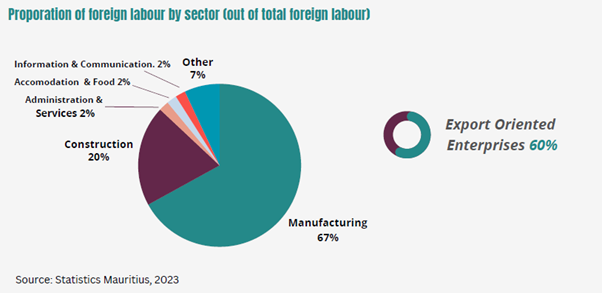
Over the past two decades, Mauritius has emerged as a host for two very distinct forms of migration. On the one hand, the country relies heavily on low-skilled labour migrants, primarily from Bangladesh, India, and Madagascar, to power its manufacturing, construction, and agricultural sectors. As of early 2024, more than 48,000 foreign workers. mostly men, were officially employed in these industries, performing essential roles that are increasingly unattractive to local workers.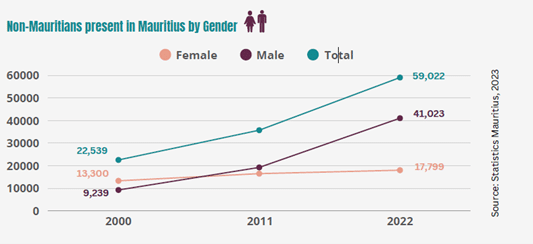
Statistics Mauritius, 2023
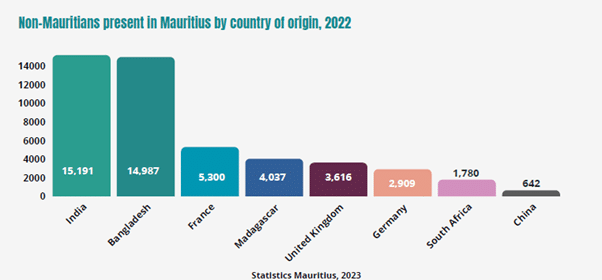
On the other hand, Mauritius has actively courted high-skilled professionals, retirees, and investors through a range of residency and permit schemes. This “elite” migration comes predominately from France, UK, Germany, South Africa and India. The schemes include the Occupational Permit system, the Retired Non-Citizen program, and investment-linked pathways such as the Premium Visa and Smart City Scheme. While fewer in number, around 7,000 holding occupational permits and 1,100 retirees, their fiscal and social footprint is significant, shaping sectors from ICT to real estate and healthcare. (Ramola Ramtohul, 2016)
The two streams of migration could not be more different in their processes and experiences in Mauritius. The two groups are served by different Ministries, enter via different recruitment schemes, and are extended different rights to work and to reside in Mauritius. At one level, this dual framework is logical because it recognizes the reality that each group enters Mauritius with different needs and resources. However, in practice, the dual framework reinforces racial, ethnic, and class hierarchies.
What unites both streams is their growing relevance to Mauritius’s long-term development. The country’s fertility rate has fallen to 1.4 children per woman, well below replacement level. This decline is coupled with a rapidly aging population: the share of the population aged 60 years and older is projected to increase from 18.7% in 2021 to 36.5% in 2061 (Ministry of Health and Wellness 2023). Without strategic migration planning, the labour force is set to shrink dramatically over the coming decades, threatening fiscal stability, public service provision, and economic competitiveness.
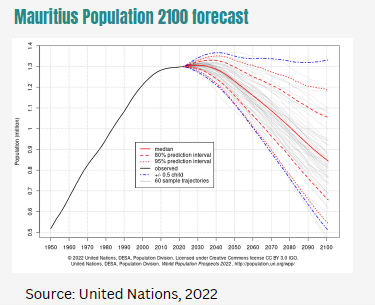
Yet, despite this urgency, Mauritius has not yet articulated a coherent, cross-sectoral migration strategy. Fragmented governance, inconsistent data, and an outdated public narrative around migration hinder the country’s ability to harness its full potential.
In June, the government of Mauritius released its proposed budget for the 2025-2026 fiscal year, signaling financial support for specific labor market and immigration improvements. The budget released to the public did not contain policy details, but it demonstrated a focus on recruiting high-skilled workers, streamlining application processes, upskilling workers to meet labor market needs, and improving the framework for lodging and accommodations for foreign workers. The budget policies speak to several issues discussed in our workshop; specifically, the need to address housing challenges for migrant workers and the need for a streamlined, rapid process for issuing worker permits and visas. Still, the migration workshop revealed several challenges that have yet to be taken up by the government in a substantial way. The budget is also unclear on whether it includes improving processes in place for low-skilled migrants or if the focus remains on high-skilled migrants.
Reframing Labour Migration: Beyond the Skills Hierarchy
Prof Roslyn Fraser emphasized the need to rethink how labour migration is framed and governed. One recurring theme was the inadequacy of the “skills-based” hierarchy that continues to shape migration discourse and policy. The term “high-skilled” is often reserved for university-educated professionals, while “low-skilled” is used to describe manual and service workers, even though the latter are often performing physically demanding, highly specialized tasks essential to the functioning of the economy.
This distinction is not only analytically flawed; it also underpins inequities in rights, remuneration, and social status. Migrants working in factories or on construction sites are seen as disposable labour inputs, not always as individuals with rights, families, and futures. At the same time, expatriates working in offices or high-tech sectors are often valorised as assets to the economy.
Prof Fraser pointed to the example of Bangladeshi migrants, who make up the largest single group of foreign workers in Mauritius, to illustrate the asymmetries embedded in recruitment, integration, and return. While Bangladeshi migration is often framed in macroeconomic terms (remittances, labour supply), the workshop highlighted the profound human and social dimensions: high recruitment fees, long periods of family separation, inadequate housing, and limited legal protection.
Ethical recruitment and dignified working conditions are imperative, especially as Mauritius remains a competitive destination offering higher wages than many sending countries. Prof Fraser raised concerns about policies that allow migration recruitment agents to act as the employer of record, which could introduce loopholes and potential exploitation. The workshop emphasized that the recruitment process and entry conditions for migrant workers in Mauritius should be understood as a shared responsibility of both the sending and receiving countries.The data gaps are equally concerning. Stakeholders noted that Mauritius lacks a real-time, disaggregated system for tracking migration trends, labour market needs, and social outcomes. Without better data, policy remains reactive rather than strategic.
The Rise of Elite Migration
Prof Ramola Ramtohul presented an analysis of the long-term impact of elite migration, specifically, the use of property investment schemes to attract high-net-worth individuals. Since 2002, Mauritius has offered non-citizens the opportunity to acquire residency through real estate purchases in Integrated Resort Schemes (IRS), Real Estate Schemes (RES), and Smart Cities. This strategy has generated billions in foreign investment and positioned Mauritius as a safe haven for global elites.
Yet the social costs are increasingly visible. Rising property prices have made housing unaffordable for many Mauritians, especially young families and middle-income earners. Spatial segregation is deepening, as gated communities, often populated by a narrow range of foreign nationalities, operate as enclaves, disconnected from the broader social fabric. In some areas, foreign residents are even displacing locals from public beaches and resources.
Initial safeguards, such as the 25% Mauritian ownership requirement in Smart Cities, have been weakened or ignored. The state has shifted from being a steward of inclusive development to a broker of exclusive spaces.
These trends pose long-term risks. If left unchecked, elite migration could exacerbate inequality, fuel resentment, and undermine the very stability that makes Mauritius attractive to investors in the first place.
Interestingly, the 2025-2026 budget has now removed all fiscal incentives for the smart city scheme, and raised the registration duty and land transfer tax for non-citizens. It remains unclear at this stage the impact these changes will have, but it signals a shift away from incentivising foreign real estate developments.
Private Sector highlight the Disconnects Between Policy and Operational Reality
Mauritius’s economy has long depended on migration to sustain its labour force and competitiveness. Yet, from the perspective of employers on the ground, migration policy and practice remain misaligned, defined more by regulatory complexity and political hesitation than by strategic planning or economic realism.
Representatives from major economic sectors shared their experiences of navigating the country’s migration framework. Their testimonies revealed a consistent theme: despite widespread acknowledgment of labour shortages and the economic necessity of foreign workers, current migration governance is ill-equipped to support business continuity, let alone national development.
The private sector’s call is clear. Without decisive reforms, Mauritius risks eroding its regional advantage as a destination for migrant labour, undermining productivity, investment, and inclusive economic growth.
Employers in hospitality, construction, and manufacturing described the daily reality of operating with insufficient staff, not due to lack of demand, but due to policy bottlenecks and worker shortages. The issue is no longer one of long-term planning; it is existential and immediate. As one participant framed it:
“We no longer ask if we have clients. We ask if we have staff, or even if we have water.”
Despite more than two decades of demographic warning signs, declining fertility, rising emigration, and an aging population, no robust system has emerged to plan for or absorb labour needs through strategic migration. The consequences are now visible in stalled development projects, declining service quality, and missed business opportunities.
Ironically, sectors that depend most on migrant labour are those least supported by current administrative structures.
An Unequal System of Migration Management
Participants pointed to inconsistency in how different categories of migrant workers are treated. Expatriate professionals enjoy relatively streamlined pathways for permits and accommodation, while so-called “low-skilled” migrant workers face onerous and fragmented processes involving multiple agencies, shifting documentation requirements, and arbitrary standards.
Housing regulations, introduced to protect vulnerable migrants, were perceived as too rigid. Employers are often forced to retrofit or abandon perfectly adequate urban housing options in order to comply with rigid and specifications perceived as illogical. These rules, participants argued, prioritise bureaucratic form over actual liveability, harming both migrants and employers without offering any measurable public benefit.
Policymaking and the Politics of Denial
Underlying these operational challenges is a more structural problem: a widening disconnect between economic realities and official narratives. Several employers described a frustrating paradox: the government continues to publish unemployment statistics that suggest a surplus of labour, while employers across sectors, from agriculture to elder care, are unable to recruit.
Up to early 2000 it was open state led strategy to welcome foreign contract labour to maintain competitiveness of the EPZ : FL were more productive mostly because they accepted working overtime and were paid less than Mauritians (Gibbons, 2008). Today, that conversation has become politically sensitive.
This silence reflects a deeper discomfort with migration as a public issue. Some private sector participants pointed that political leaders remain hesitant to acknowledge that current labour market dynamics and demographic trajectories leave no viable alternative to a more open, managed migration policy. There exists an overall feeling of frustration wherein private sector leaders feel that government policies are increasingly out of touch with the real needs of businesses in Mauritius.
Mauritius’s Competitive Edge at Risk
Regionally, Mauritius benefits from its reputation as a stable and attractive destination for migrant workers. Participants warned that inconsistent migration practices, poor worker treatment, and inefficient systems could soon deter foreign workers from choosing Mauritius in favour of destinations with clearer processes and stronger protections.
Of particular concern is the growing number of irregular migrants, estimated at around 4,800 people. Rather than developing pathways to regularization, the dominant policy response has been deportation. This not only fails to acknowledge these migrants’ economic contributions, but also sends a damaging message to the international labour market.
Systemic Discrimination and the Two-Tier Migration Framework
Public Attitudes and the Integration Gap
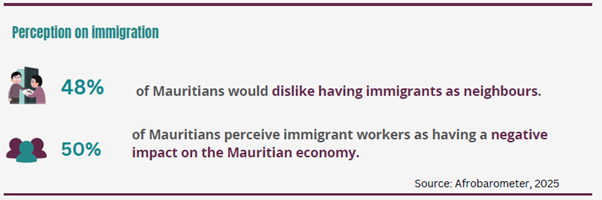
Public perceptions of migration were another focus of the workshop. A recent Afrobarometer survey found that nearly half of Mauritians are uncomfortable with the idea of having immigrants as neighbours. This discomfort reflects both economic anxieties and cultural insecurities such as fears of job displacement, crime, and erosion of national identity. Experts warn that a failure to address such attitudes will undermine social cohesion and fuel exclusionary politics.
Participants agreed that greater efforts are needed to foster integration, not only through legal rights and service access, but through symbolic and practical inclusion in everyday life. Migrant workers must be seen, heard, and valued. That means reforming recruitment practices, and promoting intercultural engagement in schools, workplaces, and neighbourhoods.
Despite the critical role that orientation and integration programs play in ensuring migrant workers’ well-being and successful adaptation, these efforts in Mauritius have been largely outsourced, by default, to the embassies of origin countries such as Bangladesh and Madagascar. These foreign missions invest significant resources to prepare and support their nationals, often stepping in where the host government has been absent. This uneven distribution of responsibility leaves a major gap in state-led integration infrastructure. The Government of Mauritius must do more to set-up and co-finance structured post-arrival orientation programs. This will not only ease migrants’ transition but also provide the Government the opportunity to shape how these programs fit within an integration and inclusion strategy that can align with international good practices and reduce potential long-term social and economic friction.
Social Consequences of a Two-Tiered System
Mauritius’ migration system is built on a deeply unequal foundation that separates migrants into two broad categories, high-skilled and low-skilled workers. This dual framework does more than simplify administrative processes; it institutionalizes systemic discrimination that reflects and reinforces racial and class hierarchies. High-skilled migrants are granted the right to both live and work in Mauritius. In contrast, low-skilled migrants face a more restricted reality: they live under employer control, are tied to company-provided housing, and have little room for economic or social mobility.
Implementation gaps in the policy framework compound the issue. While the occupational permit system was created to reduce red tape, it is often misused. Employers can exploit the system by falsely categorizing workers, thus sidestepping legal obligations. The recent decision to reduce the salary threshold for occupational permits from Rs 30,000 to Rs 22,500 opened doors for semi-skilled workers to apply. However, rather than addressing structural inequalities, this move has created new vulnerabilities. Many of these workers continue to perform the same roles as those on traditional work permits but lack proper oversight, placing them at higher risk of exploitation or even falling into irregular status.
A closer look reveals how racial and economic hierarchies permeate migration policy in Mauritius. Public and private institutions alike treat migrants differently depending on how they look and how much they earn. Participants stressed how the intersections of colourism, country origin, gender and class led to differentiated treatment in services, jobs, and bureaucracy, but also in everyday experiences and layered sources of exploitation through undocumented activities. This bias is echoed in the media, where coverage of high-skilled migrants emphasizes investment and economic success, while low-skilled workers are often associated with crime and illegality.
The situation is further complicated by contradictions between economic need and social acceptance. Employers frequently acknowledge, though rarely publicly, that migrant workers come with the right skillset and higher productivity rates than local available labour for these types of jobs. These workers fill essential labour shortages, particularly in industries where there is either a lack of local interest or a genuine skills gap. Yet, political sensitivities and societal prejudices prevent an honest public conversation about the country’s economic dependence on migrant labour.
While many employers do provide decent working and living conditions, suggesting that better practices are both possible and replicable, there is reported evidence that abuse continues. Small and medium-sized enterprises, under financial pressure, often fall short in meeting minimum welfare standards, leading to exploitative conditions. Participants also raise concerns about regulatory arbitrage, where policy shifts are reactive, designed to address immediate backlogs rather than long-term needs. Without robust monitoring systems, many migrants fall through the cracks, invisible to both government and their home embassies.
Towards a Rational and inclusive Migration framework
Migration is now central to Mauritius’ socioeconomic landscape. From high-skilled labour in strategic sectors to low-wage labourers underpinning key industries like hospitality and construction, migrants have become vital contributors to the country’s development trajectory.
Our discussions highlighted a pressing need for a comprehensive, rights-based migration strategy that can govern the increasing complexity of migration in Mauritius. Such a strategy must rest on four key pillars: institutional coordination, labour market reform, worker protection, social integration.
1. Building an Integrated and Evidence-Based Migration Framework
Mauritius must urgently move beyond ad hoc schemes and develop a national migration policy rooted in demographic realities, development priorities, and a strong human rights foundation. This policy should be underpinned by robust, transparent data systems and multi-level institutional coordination.
- Develop a national migration information system that tracks not only migration flows, but also outcomes such as employment, education, housing, and integration.
- Establish a Migration Knowledge Network to facilitate coordinated policymaking, enable stakeholder learning, and disseminate evidence.
- Strengthen operational capacity of existing institutions, including anti-trafficking infrastructure, welfare support and collaboration with embassy services that provide vital support to migrants.
2. Reforming Labour Market Policies to Match Economic Realities
The Mauritian economy is structurally reliant on migrant labour, particularly in sectors experiencing persistent labour shortages. However, current permit systems and employment practices are fragmented and ill-suited to long-term planning.
- Standardise permit durations across skill categories to support business continuity and fair treatment.
- Regularise irregular migrants who are already embedded in the economy, particularly in sectors with sustained demand.
- Acknowledge the structural reliance on foreign labour by aligning economic strategy with proactive legal pathways to permanent residence.
- Reinforce the application of local quotas for high-end real estate developments to protect community interests.
- Cap foreign acquisitions in high-pressure zones, particularly where local residents face displacement or exclusion.
- Link investment and residency schemes to broader affordability, social equity, and sustainability goals.
3. Guaranteeing Safety, Dignity, and Protection for Migrant Workers
Ensuring migrant workers’ rights is not only a moral imperative, it is essential for building a functional and sustainable labour system. Current gaps in contract literacy, insurance coverage, and regulatory oversight expose workers to avoidable risks and exploitation.
- Strengthen regulation of recruitment agencies, including the establishment of clear grievance channels.
- Mandate legally binding minimum insurance thresholds, aligned with economic contributions and family needs.
- Require contracts to be translated and explained orally in workers’ native languages to enhance informed consent and legal protection.
- Review approach to decent housing standards to allow better integration for workers and flexibility for employers while ensuring quality standards, dignity and safety for all workers.
- Establish Welfare support schemes in partnership with employers and ambassies, to ensure more vulnerable workers have adequate support for adaptation and integration.
4. Fostering Social Integration and a Shared Sense of Belonging
Integration must be approached as a two-way process, requiring action from both host institutions and migrant communities. Current efforts are minimal, leaving space for misunderstandings, stereotypes, and exclusion.
- Develop an Integration and Inclusion policy and strategy with cleat action plans for the better inclusion and integration of migrants in Mauritius.
- Develop post-arrival orientation programs addressing legal rights, cultural norms, available services, and grievance mechanisms.
- Launch community-level initiatives such as intercultural events and dialogue forums to foster mutual understanding.
- Train public service providers in anti-discrimination practices, particularly in health, education, and law enforcement sectors.
- Address the needs of second-generation migrants, particularly regarding access to education and language acquisition.
- Promote balanced, fact-based media narratives through training and ethical journalism guidelines.
- Adopt intersectional policy frameworks that recognize the diverse vulnerabilities and identities within migrant populations.
- Prepare society for greater diversity through inclusive education and public dialogue initiatives, aimed at fostering a shared national vision of multiculturalism.
Conclusion
Migration has never been a peripheral issue for Mauritius, it is central to the nation’s past and will shape its future. Today, Mauritius faces an opportunity to lead with vision and integrity on the issue of migration. The country’s economic vitality and sustainability depend on the people it welcomes through its borders. Yet the current system is marked by fragmentation and inequality, which risks undermining the very prosperity it seeks to secure.
Mauritius has the chance to embrace a migration framework grounded not only in efficiency and economic logic but also in empathy and fairness. Policies must reflect the lived experiences of all migrants, whether they manage finance, work in technology, build roads, care for the elderly, or support industry. With a proactive and progressive strategy, Mauritius can ensure that dignity, protection, and belonging will not be privileges reserved for a few; they can be preserved as rights for all. While it is reasonable to design distinct pathways that respond to the specific needs and resources of high- and low-skilled migrants, care must be taken to ensure that such distinctions do not enshrine a hierarchy of belonging in law or practice. A system that meets people where they are should not, by default, grant some the full benefits of participation while relegating others to the margins. As a nation proud of its multicultural heritage, Mauritius has the opportunity, and indeed the responsibility, to lead by example. Reforms must be guided by a renewed commitment to inclusion, a respect for human rights, and a vision of shared prosperity.
Let us build a migration system that honors the values at the heart of the Mauritian identity: resilience, diversity, and solidarity.
Main photo from Freepik
Charles Telfair Centre is an independent nonpartisan not for profit organisation and does not take specific positions. All views, positions, and conclusions expressed in our publications are solely those of the author(s).