

Original working paper by:
Henri Casella, Senior Environmental Economist Consultant
Jaime de Melo, Emeritus, University of Geneva, IEC, FERDI
Summary
African Small Island Developing States (SIDS); Cabo Verde, Comoros, Guinea-Bissau, Mauritius, São Tomé and Príncipe, and Seychelles, depend heavily on international trade. At the same time, they are among the most vulnerable to environmental degradation and climate change (Nurse et al 2014, figure 29.2; Robinson 2020, Mc Gilivray et al 2010). Their challenge is that trade sustains their economies, but it also contributes to the ecological pressures that threaten their future (Fischer, 2011).
This study highlights how African SIDS can reshape their trade policies to better protect the environment while deepening their participation in regional integration, particularly under the African Continental Free Trade Area (AfCFTA). It shows what has been missing so far, where opportunities lie, and what steps governments could take immediately.
Trade without environmental safeguards
Natural ecosystems in African Small Island Developing States (SIDS) face mounting threats from climate change and biodiversity loss. While global climate pressures are beyond their control, these islands can act to curb local degradation. For instance, by protecting coastal zones, managing habitats, and ensuring sustainable fisheries within their vast Exclusive Economic Zones.
An Environmental Dashboard is a valuable tool for tracking both the scale of these threats and the effectiveness of policy responses. The urgency is clear: environmental degradation is occurring faster in African SIDS than in many other countries. Because their economies are small and highly exposed, the costs of adapting are relatively high, and they will only grow the longer policy action is delayed.
Because of their dependency on international trade and their vulnerability to environmental degradation, SIDS depend on an environmentally friendly world trading system, which is yet to be delivered. Trade and environment policies continue to be designed separately on the world stage in spite of the increase in physical linkage across countries.
So far, African and global trade agreements have done little to help. At the World Trade Organization (WTO), negotiations to better align trade with environmental goals have stalled. At the African regional level, trade blocs have included only limited and weakly enforced environmental provisions. And the new AfCFTA, which promises to transform intra-African trade, does not even mention the environment in its preamble.
This omission matters. Without integrating environmental safeguards into trade rules, economic integration risks accelerating resource depletion and locking small islands into unsustainable paths.
Our framework: an environmental dashboard
To better understand the challenges facing African SIDS, our study proposes an Environmental Dashboard that combines multiple indicators into three broad categories:
1. Physical vulnerability to climate change (for example, exposure to temperature changes and extreme weather). These are exogenous risks that small islands cannot control.
2. Current health of the environment, measured, for instance, through the Red List Index, which captures the risk of species extinction.
3. Preparedness to respond to environmental challenges, using the global Environmental Performance Index (EPI) and a modified version tailored to SIDS (EPISI) to reflect their specific circumstances.
This dashboard allows comparisons across African SIDS, with other small islands worldwide, and with larger African economies. The approach distinguishes between what islands cannot control (climate shocks) and what they can influence through domestic policy (biodiversity protection, pollution control, governance).
One striking finding is that wealth does not guarantee good performance. Some of the better-off African islands, such as Mauritius and Seychelles, lag behind in ecosystem conservation, even though their economies depend heavily on healthy marine and terrestrial environments.
Environment Dashboard for SIDS
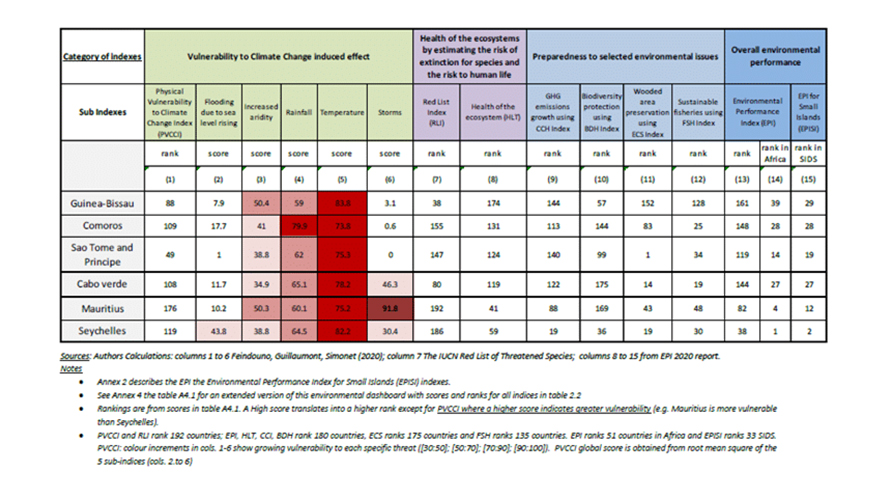
Two lessons stand out. First, for some aspects, higher GDP per capita is correlated with higher environmental performance. But this is not the case for the conservation of ecosystems, where some relatively wealthy African SIDS, such as Mauritius, underperform compared to peers. Second, among higher income Arican SIDS, Seychelles consistently outperforms Mauritius on environmental performance, a reflection of Seychelles’ pro-active policies on climate change and biodiversity loss.
What can be done: three policy options
The study proposes three possible strategies for African SIDS.
1. Work through AfCFTA
At the most ambitious level, African SIDS could push for AfCFTA to incorporate environmental provisions in its second negotiation phase. This would mean:
- Adding environmental protection to the treaty’s preamble.
- Ensuring environmental goods are not excluded from tariff reductions.
- Introducing standards on issues like public procurement and certification to avoid a “race to the bottom.”
The advantage of this route is scale: reforms would apply continent-wide. But the pace is slow, with tariff elimination stretching over a decade, and political appetite for an environmental agenda remains limited.
2. Act unilaterally
The fastest route is unilateral action. LDC African SIDS could immediately remove tariffs on environmental goods, which only account for 1- 3% of imports, without waiting for regional consensus. This would lower the cost of clean technologies and environmental management tools. For fiscally constrained governments, the revenue loss would be minor compared to the potential gains.
3. Form a “small club”
Finally, African SIDS could join forces with like-minded partners to pioneer a green trade agenda, inspired by the Agreement on Climate Change, Trade and Sustainability (ACCTS) launched by New Zealand, Costa Rica, and others. Such a coalition could include the:
- Elimination of fossil fuel subsidies.
- Promotion of eco-labelling standards.
- Development of joint policies for marine resource management, especially fisheries.
For small tourism-dependent islands, being seen as environmental leaders also brings reputational benefits that attract investment and visitors.
The way forward
A pragmatic strategy would combine quick national actions (like removing tariffs on environmental goods) with longer-term regional and international lobbying. This dual approach would allow African SIDS to safeguard ecosystems urgently while working towards embedding environmental priorities in African trade frameworks.
Above all, trade cannot be treated separately from the environment. For small islands, sustainability is a must, it is the foundation of their economies and their survival.
If African SIDS embrace bold, green trade policies now, they can protect their unique ecosystems, strengthen resilience to climate change, and carve out a leadership role in shaping a greener African integration. The window of opportunity is narrow, but the stakes could not be higher.
References:
ACCTS (2019) Joint Leaders’ Statement on the Launch of the ‘Agreement on Climate Change, Trade and Sustainability’ https://www.beehive.govt.nz/sites/default/files/2019-09/ACCTS%20joint%20leaders%20statement.pdf
Casella, Henri, and Melo, J. de (2021) “Greening Trade Policy in African Small Islands Developing States: Suggestions for the Way forward under the African Continental Free Trade Area (AFCFTA)”, FERDI WP #295, https://ferdi.fr/en/publications/greening-trade-policies-in-african-small-islands-developing-states-afsids-suggestions-for-the-way-forward-under-the-african-continental-free-trade-area-afcfta
Fischer, C. (2011) “Does Trade help or hinder the conservation of natural resources”, Review of Environmental Economic Policy, 4(1), 103-21
Helbe, M., and B. Shepherd eds. (2017) Win-Win: How international trade can help meet the Sustainable Development Goals, Asian Development Bank, https://www.adb.org/sites/default/files/publication/327451/adbi-win-win-how-international-trade-can-help-meet-sdgs.pdf
McGillivray, M., Naudé, W., Santos-Paulino, A.U.(2010) Vulnerability, Trade, Financial Flows and State Failure in Small Island Developing States 46. 46/005. The Journal of Development Studies. 10.1080/00220381003623822
Nurse, L.A., McLean, R.F., Agard, J., Briguglio, L.P., Duvat-Magnan, V., Pelesikoti, N., et al., 2014. Small Islands. In: Barros, V.R., Field, C.B., Dokken, D.J., Mastrandrea, M.D., Mach, K.J., Bilir, M. (Eds.), Climate Change 2014: Impacts, Adaptation, and Vulnerability. Part B: Regional Aspects. Contribution of Working Group II to the Fifth Assessment Report of the Intergovernmental Panel on Climate Change. Cambridge University Press, Cambridge, United Kingdom and New York, NY, USA, pp.1613–1654.
Robinson, Stacy‐ann. “Climate change adaptation in SIDS: A systematic review of the literature pre and post the IPCC Fifth Assessment Report.” Wiley Interdisciplinary Reviews: Climate Change (2020): e653. https://onlinelibrary.wiley.com/doi/pdf/10.1002/wcc.653
WTO (2010) “Trade in Natural Resources” World Trade Report, https://www.wto.org/english/res_e/publications_e/wtr10_e.htm
WTO-UNEP(2018) Making Trade Work for the environment, prosperity, and resilience, https://www.wto.org/english/res_e/publications_e/unereport2018_e.htm
Other research by the authors:
Melo, J. de (2020) « Negotiations for an Agreement on Climate Change, Trade and Sustainability (ACCTS): An Opportunity for Collective Action » https://www.tradeeconomics.com/wp-content/uploads/2020/04/JDM-ACCTS-2.pdf 35
Melo, J. de, and Jean-Marc Solleder (2020a). “The EGA Negotiations: why they are important, why they are stalled, and challenges ahead.” Journal of World Trade 54.3.
Melo J.de , Solleder J-M. (2020b) “Barriers to trade in environmental goods: How important they are and what should developing countries expect from their removal”, World Development, vol. 130. Melo, J. de, J.M. Solleder and Z. Sorgho (2020) “A Primer on African Market Integration with a Hard Look at Progress and Challenges Ahead”, https://ferdi.fr/publications/a-primer-on-african-market-integration-with-a-hard-look-at-progress-and-challenges
Main photo from Pexels
Charles Telfair Centre is an independent, nonpartisan not for profit organisation and does not take specific positions. All views, positions, and conclusions expressed in our publications are solely those of the author(s).